Aquatest Research Programme
In October 2007, after initial European Union funding, the Bill & Melinda Gates Foundation awarded the University of Bristol a grant to research and develop a user-friendly, low-cost water quality test that can be used on-site in developing country field conditions and to prepare for the future introduction of the test in developing countries.
Our vision is that by 2017, low-cost water testing devices will be widely used in 80 percent of developing countries. The devices will be used by water professionals, community groups and part-time/volunteer supply managers who won't need specialist scientific knowledge to use the test kits or interpret the results.
Aquatest device
 |
|
Aquatest incubator
 |
|
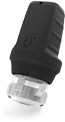
Aquatest UV torch
 |
|
Aquatest Water Quality Reporter
 |
Water Quality Reporter (WQR) is a cell phone application for:
water test results to a central database
|
Aquatest tutorials
- A step-by-step video guide to using the Aquatest system
Your device doesn't support direct playback. Please download the video (MP4) instead.
Pilot scheme
The final stage of the Aquatest research and development process was to take the technology out of the lab and put the device in the hands of the end users.
In November 2011 an extensive pilot scheme began to test c.10,000 devices in the field in partnership with 17 organisations in 16 countries:
- Water suppliers: Kenya, Vietnam, Morocco, Sri Lanka, Ecuador, Cambodia, Bolivia, S. Africa, Mozambique, Canada
- Health surveillance agencies: Bolivia, S. Africa, Mozambique, Canada
- International NGOs and researchers: India, DRC. Somaliland, Bangladesh, Kenya, Ghana
The Aquaya team conducting a landscaping survey to understand:
- who is responsible for water quality testing;
- current testing capacity;
- technologies in use; and
- constraints to water quality testing.

Following on site training, feedback was obtained on the experience of end-users and institutional managers through semi-structured interviews and direct observation of testing data.
Useful links
International Agency publications
- WHA Resolution 64/24 on Drinking Water, Sanitation and Health, a resolution adopted by the World Health Assembly urging Member States, to highlight the importance of safe drinking-water, sanitation and hygiene as the basis for primary prevention in national public health strategies
- Millenium Development Goals and beyond 2015. We can end poverty.
Low-cost water testing
- Water quality testing kits for field use from the India Water Portal provides some links and background information
- An existing low-cost water test kit, which includes a microbiological test for coliform bacteria
- Low-cost water testing under development from the Massachusetts Institute of Technology. Particularly focused on a low-cost field incubator
- Managing drinking water in remote rural communities. Issues being considered by a network coordinated by the The World Health Organisation
Regional drinking water sites
- The Rajiv Gandhi National Drinking Water Mission provides a wealth of information about drinking water in India
- The Water Research Commission within South Africa publishes the journals Water SA and Water Wheels, as well as a wide range of research reports
General drinking water resources
- The World Health Organisation’s Guidelines for Drinking Water Quality. The site also contains resources on small community water supply management and the H2S method for detecting fecal contamination of drinking water
- The International Water Association is a professional body that organises many water-related events and has a wide portfolio of publications, including several journals, such as the Journal of Water and Health
- The Global Water Challenge is a coalition of 22 organisations working to provide safe water and sanitation

Consortium partners
|
|
|
|
|
|
|
|
|
|
|
|
Other organisations involved |
|
|
|
|
|
|
|